The Jewish Etamology of Ostraliye / Eretz-Or
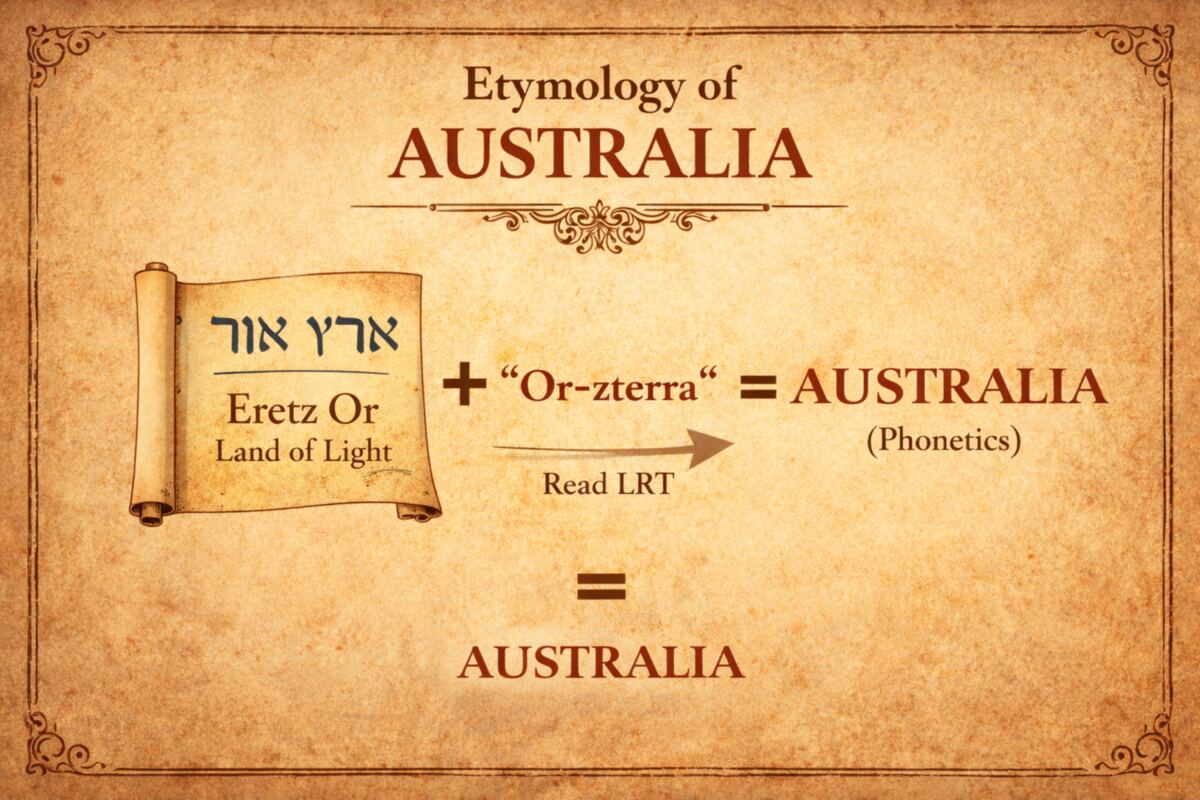
Eretz-Or and Ostraliye: A Comparative Etymological Hypothesis A Jewish linguistic reading of the name “Australia”
I would like to present a linguistic hypothesis concerning the name Australia, approached from a Jewish rather than exclusively Western European linguistic perspective.
This is not presented as a settled etymology. It is an invitation to examine a surprisingly simple collection of linguistic and historyical correspondences and to consider whether the word may contain older layers than the conventional explanation recognises.
The starting point is Hebrew: ארץ אור — Eretz Or
Eretz (ארץ) means land. Or (אור) means light.
Thus Eretz-Or can straightforwardly be read as “Land of Light.”
The question I began investigating was whether this expression, or something descended from it, could have travelled through Jewish communities and the maritime trading world eastward.
The Yiddish clue
The investigation became considerably more interesting when I looked at the Yiddish name for Australia:
אוסטראַליע — Ostraliye
Rather than beginning with its English spelling, consider the word as a Yiddish speaker encounters it.
It can be divided phonetically:
אוסט | ראַ | ליע Ost | ra | liye
The first component immediately invites comparison with the Germanic Ost, “east.” Yiddish developed in a multilingual Jewish environment with a predominantly Germanic grammatical and lexical base together with substantial Hebrew-Aramaic and Slavic components.
This gives us the first semantic element:
OST → EAST
The second observation emerged when the final portion of the word was compared with Portuguese ilha, “island,” pronounced approximately EE-lya.
Written phonetically into Yiddish, ilha can be represented approximately as:
איליאַ — ilya
The similarity becomes particularly striking when the forms are placed beside one another:
Ost + ilha / ilya East + island
and:
אוסטראַליע — Ostraliye
The intervening r remains a question requiring investigation. I am not proposing that every letter has already been accounted for.
I am proposing that the larger construction deserves examination.
Why Portuguese?
At first sight, combining a Germanic/Yiddish particle with a Portuguese particle may appear unusual.
For Yiddish, however, multilingual formation is hardly an exotic concept. Jewish communities historically lived among speakers of numerous languages, and Yiddish itself contains vocabulary acquired through prolonged language contact.
The relevant historical environment is therefore not an isolated nation-state. It is the merchant, port and maritime network connecting Jewish communities across Europe, the Mediterranean, Persia, India and maritime Asia.
Such networks were inherently multilingual.
And linguistic transmission through trade is bidirectional. A word carried along a trading network need not move west-to-east simply because later European records were written in European languages. People, stories, navigational knowledge and words can travel in either direction.
The appropriate historical question is therefore not merely:
“Which later European language contains a similar word?”
It is also:
“What words were being spoken by the communities actually moving along these routes, and what earlier oral forms might they have carried?”
An unexpected speaker test
I subsequently tested the observation informally within my own Jewish community.
I showed the construction to a rabbi, who immediately understood what I was pointing to and described the correspondence as “amazing.”
More significantly, I discussed it with a speaker familiar with both Yiddish and Portuguese. When presented with the relevant sound, he independently asked whether the iliya component meant “island.”
This is not historical proof, nor do I present it as such.
It is nevertheless useful linguistic evidence of a different kind: the proposed particles are perceptible to speakers of the languages concerned without requiring an elaborate reconstruction.
The hypothesis can effectively be demonstrated in two words:
OST + ILHA
EAST + ISLAND
From Eretz-Or to Ostraliye
This raises a larger possibility.
Rather than assuming that the surviving modern word represents a single linguistic event, I am investigating whether it contains successive linguistic layers produced by Jewish migration, commerce, navigation and multilingual contact.
One possible conceptual progression is therefore:
ארץ אור — Eretz-Or Land of Light
↓
Jewish linguistic and maritime transmission
↓
Ost + ilha / ilya East + Island
↓
אוסטראַליע — Ostraliye
↓
Australia
I emphasise that the arrows above represent a research hypothesis, not a claimed documentary chain.
The purpose of the hypothesis is precisely to ask whether such a chain once existed.
The problem of written evidence
There is an additional methodological issue when researching Jewish linguistic history.
Jewish history cannot always be reconstructed by assuming that the oldest surviving European document represents the first existence of a word, tradition or journey.
Jewish communities possessed strong traditions of oral transmission, while Jewish manuscripts, libraries and communities repeatedly suffered destruction, displacement and confiscation over many centuries.
Consequently:
earliest surviving written attestation ≠ necessarily earliest spoken usage.
This does not mean that documentary evidence is unimportant. Quite the opposite: finding an early Hebrew, Yiddish, Judeo-Persian, Judeo-Arabic, Portuguese or other maritime occurrence would be extremely valuable.
It means only that absence from the surviving written corpus cannot by itself reconstruct the complete history of an orally transmitted word.
A second question: Eretz and terra
The same investigation raises another comparison that I regard as unresolved rather than demonstrated:
ארץ — Eretz — land
and
terra — land
The resemblance becomes particularly interesting when Hebrew's right-to-left writing tradition encounters left-to-right European scripts.
I am investigating whether copying, transliteration, reinterpretation or multilingual oral transmission could have contributed to transformations of this sort.
Again, resemblance alone does not establish descent.
But neither should resemblance combined with historically plausible contact automatically be excluded simply because a later language possesses the same word.
The chronological direction of borrowing is itself something to investigate.
What I am proposing
I am therefore not asking the reader to discard the conventional etymology and replace it with mine.
I am asking a different question:
Does the name Australia preserve an older Jewish-maritime linguistic layer that has not previously been recognised?
My present observations are:
Eretz = land. Or = light. Ost = east. Portuguese ilha = island. Yiddish אוסטראַליע (Ostraliye) contains a striking phonetic arrangement of these latter sounds. Jewish communities historically operated within multilingual trading networks through which words could move in either direction.
The resulting semantic progression—
Land of Light → Eastern Island → Ostraliye
—is sufficiently coherent to warrant investigation.
The strongest test now is not argument.
It is to put the construction before Hebrew speakers, Yiddish speakers, Portuguese speakers, rabbis, Jewish historians, sailors and scholars of historical Jewish trade networks and ask a very simple question:
What do you hear when you read it?
That is where I am presently leaving the hypothesis: open, testable, and awaiting further evidence.
David Lyon Sydney, Australia 2026