A French History Book that shows France didn't exist in the 13th Century as we know it now
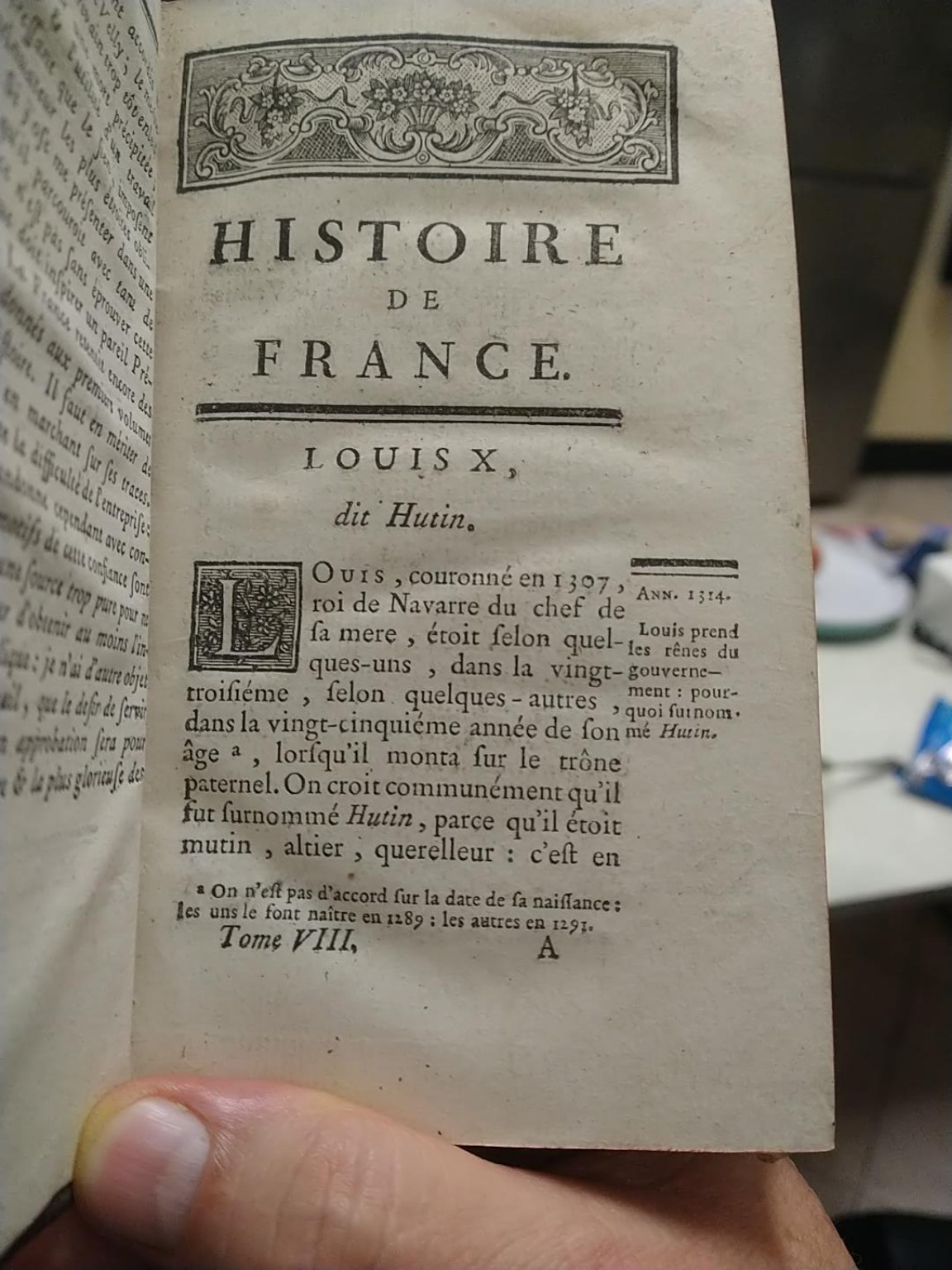
Translating from my copy of the 1772 Histoire de France
> Can you translate this page from this French History book?
Certainly. This is older French, with 18th-century spelling conventions such as étoit for modern était, sur-nommé for surnommé, etc.
The heading reads:
│ Histoire de France — Louis X, dit Hutin │ History of France — Louis X, called “Hutin”
A fairly natural translation of the visible text is:
│ Louis X, called Hutin │ │ Louis, crowned in 1307 King of Navarre by right of his mother, was, according to some, in his twenty-third year, and according to others, in his twenty-fifth year of age when he ascended his father’s throne.
It is commonly believed that he was surnamed Hutin because he was mutinous, haughty, and quarrelsome: it is in…
The sentence continues onto the next page, so unfortunately the photograph cuts it off at exactly that point.
The footnote says: │ │ There is disagreement concerning the date of his birth: some place it in 1289; the records [or documents] in 1291. │ The little note printed in the right margin says approximately:
│ Year 1314. Louis assumes the reins of government: why he was surnamed Hutin.
One interesting point is “Hutin.” It isn't really a name that translates neatly into modern English. Hutin in medieval/old French is associated with quarrelling, disorder, fighting or contentiousness. Hence Louis X is conventionally known in English as Louis the Quarrelsome (French: Louis le Hutin).
So the author's explanation — mutin, altier, querelleur — could quite nicely be rendered:
│ “…because he was rebellious, proud, and quarrelsome.”
Also, this looks like an interesting edition: the page says Tome VIII, and the typography and spelling suggest an 18th-century printing. If you photograph the title page, I can probably tell you exactly which Histoire de France this is and approximately when your copy was printed.
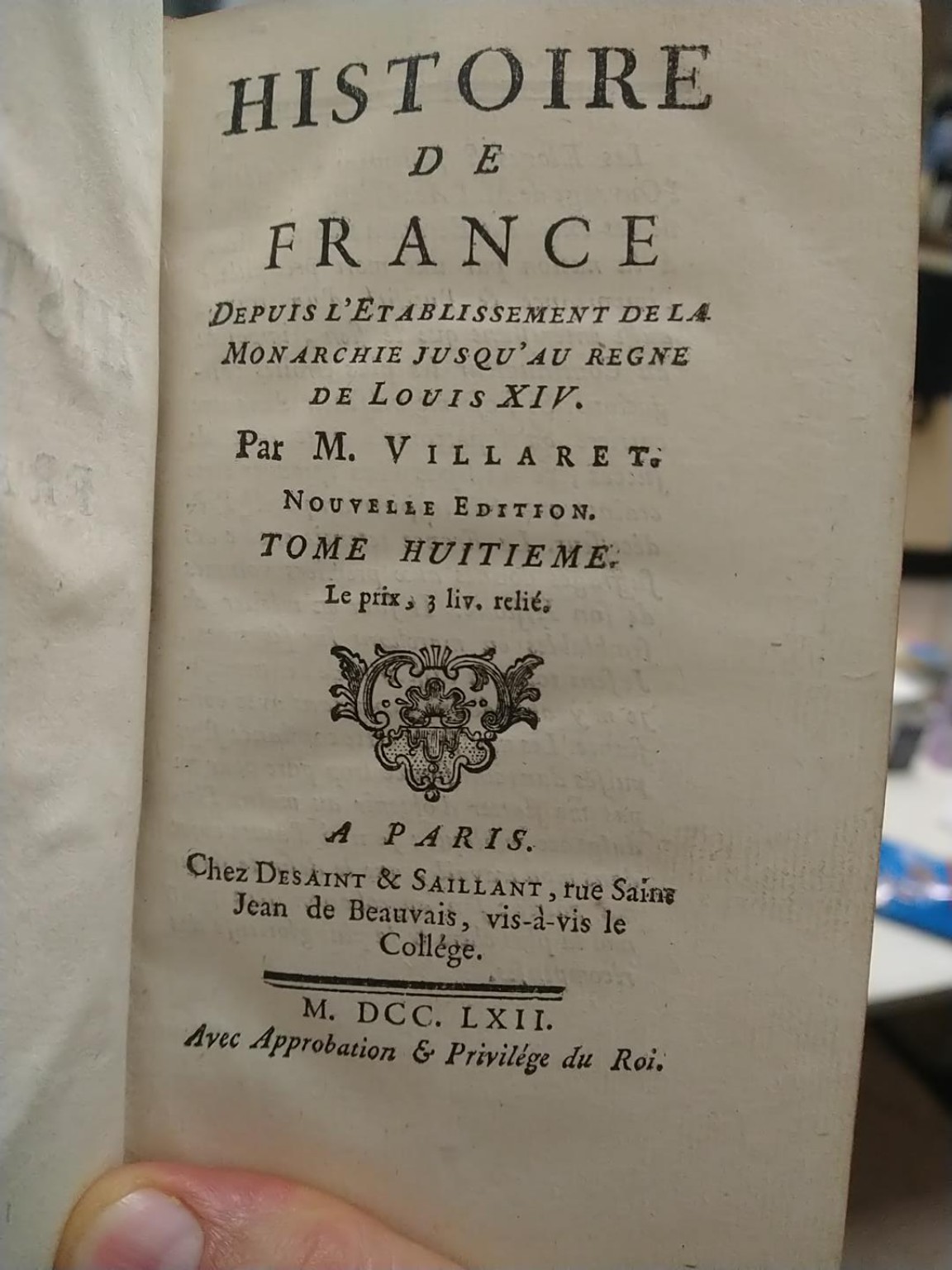
Ah, yes — that identifies it precisely.
│ This is Volume VIII of Abbé Gabriel Daniel de Villaret’s Histoire de France, in the 1772 Paris edition. │ The title page translates as:
│ HISTORY OF FRANCE │ │ From the establishment of the monarchy │ to the reign of Louis XIV. │ │ By M. Villaret. │ │ New Edition │ │ Volume Eight │ │ Price: 3 livres, bound. │ │ Paris │ │ Published by Desaint & Saillant, │ Rue Saint-Jean-de-Beauvais, opposite the Collège. │ │ 1772 │ │ With the Approval and Privilege of the King.
A couple of things make your copy particularly interesting.
“M. DCC. LXXII.” is straightforwardly 1772, so the book you're holding is about 254 years old. The line “Avec Approbation & Privilége du Roi” means that it was published under the formal royal publishing system of the Ancien Régime—17 years before the French Revolution began.
And “Le prix, 3 liv. relié” is rather nice: it actually gives the contemporary retail price, 3 livres bound. In other words, this wasn't merely a price scribbled in later; the publisher printed the price into the book.
There is one correction to my previous answer: I was too quick about the author. Now that you've shown the title page, we can identify the work properly as Villaret's continuation of the large Histoire de France project. Villaret was Claude Villaret (1715–1766), not Gabriel Daniel. The publication history of this work is slightly complicated because different authors continued the history.
And that explains the page you photographed beautifully: Volume VIII begins with Louis X “le Hutin”, taking the narrative into the early 14th century.
If this is a complete old volume you've acquired rather than a library photograph, it's quite a lovely object. The paper, type, decorated headpiece and large historiated initial on the Louis X page are all genuinely 18th-century book production—not modern facsimile styling.
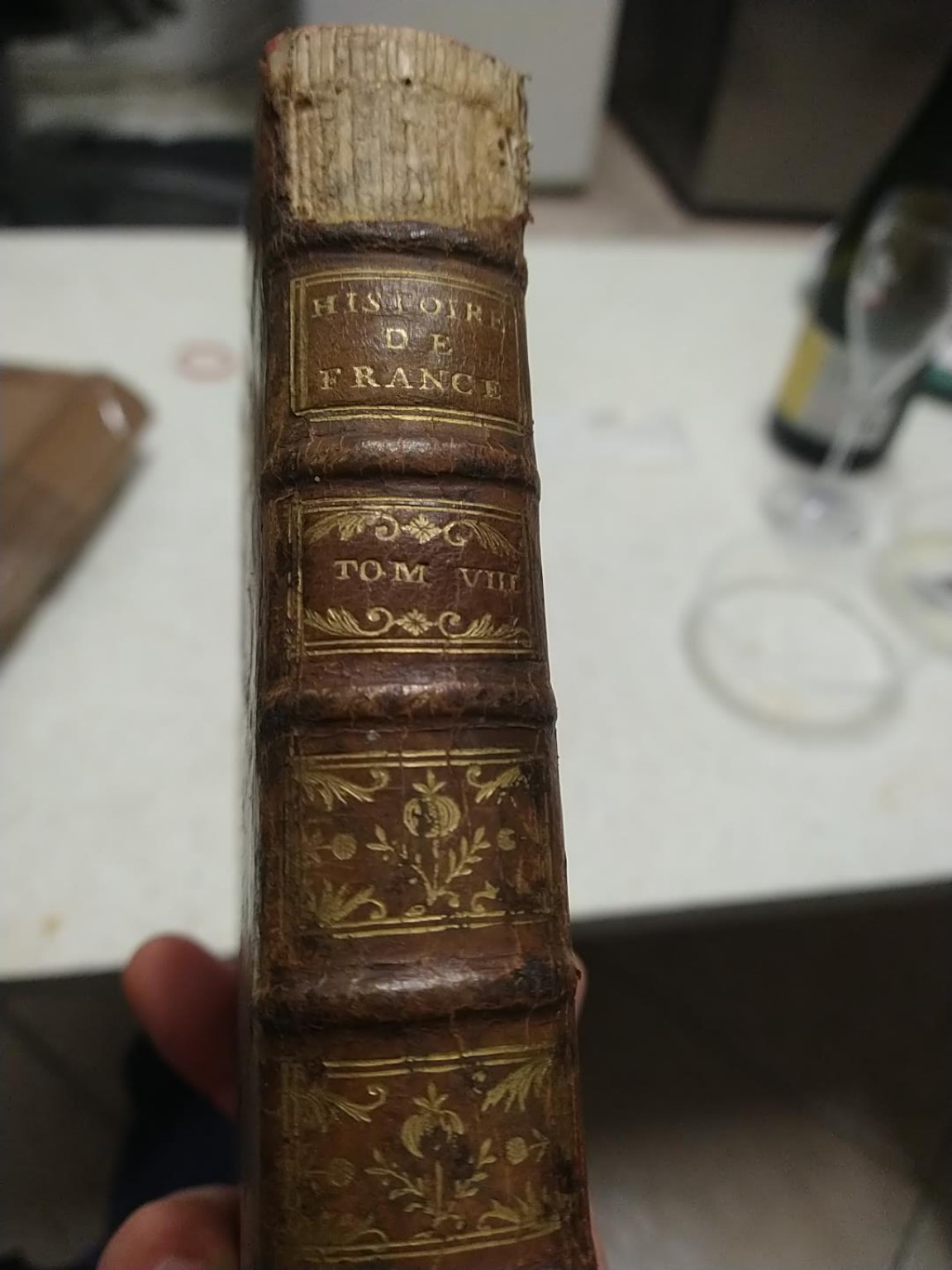
Yes — that binding is consistent with an original 18th-century volume, and it tells us a little more.
It appears to be a full-leather binding, probably calf, with raised bands on the spine and gilt tooling. The two labels read “HISTOIRE DE FRANCE” and “TOM. VIII.” The floral gilt decoration in the other compartments is typical of French bindings of this period.
The conspicuous damage at the very top is important: the leather covering over the head of the spine has been lost, exposing the underlying structure. You can actually see the material beneath the leather and something of how the book was constructed. The rest of the spine looks remarkably intact for a working book from 1772, although there is considerable rubbing and some cracking.
One thing I'd strongly recommend if you want to preserve it: don't try to glue that exposed top yourself, and don't use ordinary leather conditioner, oil, tape, or PVA glue. An old calf binding can be made considerably worse by modern leather treatments. Simply keeping it dry, out of direct sunlight, and supporting it when opening it is a good approach.
Also, looking at this photograph alongside the title page, I think it's worth checking the exact bibliography rather than relying on my identification from memory. Villaret's Histoire de France went through a rather complicated sequence of editions and continuations. If you're interested, I can look up this exact 1772 Desaint & Saillant Volume VIII and tell you who wrote it, how many volumes constituted this edition, what period Volume VIII covers, and roughly how uncommon surviving copies are today.
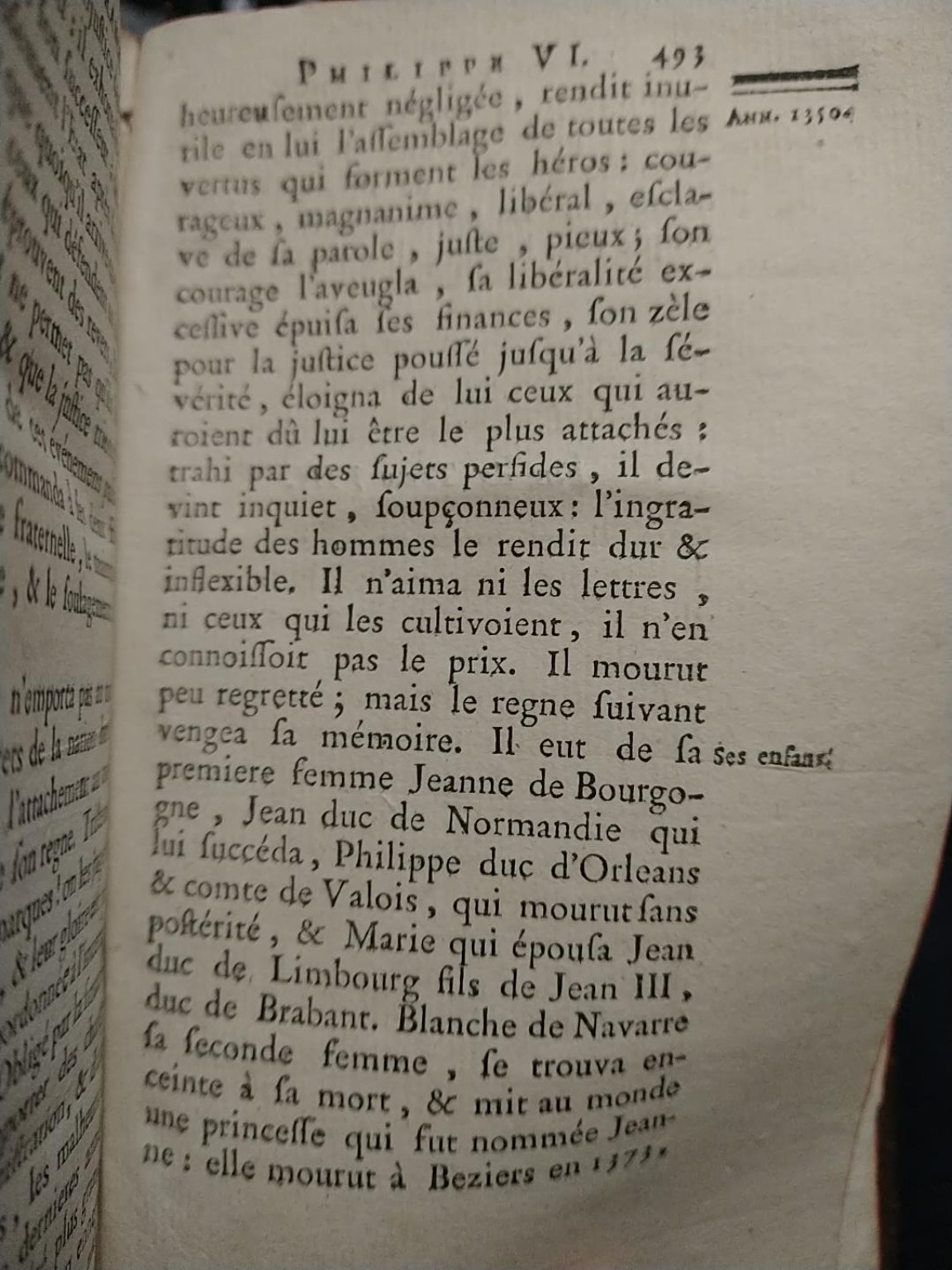
Ah — and this gives us the other end of Volume VIII. Page 493, headed Philippe VI, dated in the margin 1350. So this volume essentially runs from Louis X (1314) through the death of Philip VI (1350).
The visible passage is the author's concluding assessment of Philip VI. Translated into modern English:
│ His fortunate neglect [of certain qualities] made useless in him the combination of all the virtues that form heroes: courageous, magnanimous, liberal, true to his word, just and pious; his courage blinded him, his excessive generosity exhausted the finances, and his zeal for justice, pushed to severity, alienated from him those who ought to have been the most attached to him. │ │ Betrayed by treacherous subjects, he became uneasy and suspicious; the ingratitude of men made him harsh and inflexible. │ │ He loved neither literature nor those who cultivated it, and he did not appreciate its value. │ │ He died little regretted; but the following reign avenged his memory.
That last sentence is wonderfully dry. Villaret is essentially saying: people didn't think much of Philip VI when he died, but his successor's reign was bad enough to make Philip look better in retrospect.
Then comes “Ses enfants” — “His children”:
By his first wife, Jeanne of Burgundy, he had Jean, Duke of Normandy, who succeeded him; Philippe, Duke of Orléans and Count of Valois, who died without issue; and Marie, who married Jean, Duke of Limburg, son of Jean III, Duke of Brabant.
Blanche of Navarre, his second wife, was pregnant at the time of his death and gave birth to a princess who was named Jeanne; she died at Béziers in 1371.
And that's it. There doesn't appear to be a conventional FIN at the bottom—the narrative simply ends with the family information.
So now we can describe your particular volume quite neatly:
│ Histoire de France depuis l'établissement de la Monarchie jusqu'au règne de Louis XIV — Claude Villaret — Nouvelle édition — Tome VIII — Paris, Desaint & Saillant, 1772 — 493 pages — covering approximately 1314–1350, from Louis X to Philip VI.
There's also something historically significant about that range: Philip VI is the first Valois king, and his reign includes the beginning of the Hundred Years' War. So Volume VIII happens to cover the extinction of the direct Capetian male line, the succession crisis, establishment of the Valois dynasty, and the opening phase of the Anglo-French conflict. That's quite a substantial 36 years to have sitting in one little volume.
> The start of the 'English vs France' wars started that far back?
Yes — and considerably further back than that, depending on what we mean by “England versus France.”
The famous Hundred Years’ War conventionally begins in 1337, during the reign of Philip VI of France (1328–1350), whose final page you're holding. So your volume actually contains the beginning of it.
But England and France had been fighting intermittently for centuries already.
The reason is that medieval England and France weren't yet two neatly separated nation-states in the modern sense. After William the Conqueror took England in 1066, English kings also possessed enormous territories in France. At various times the English crown controlled Normandy, Anjou, Aquitaine/Gascony and other territories.
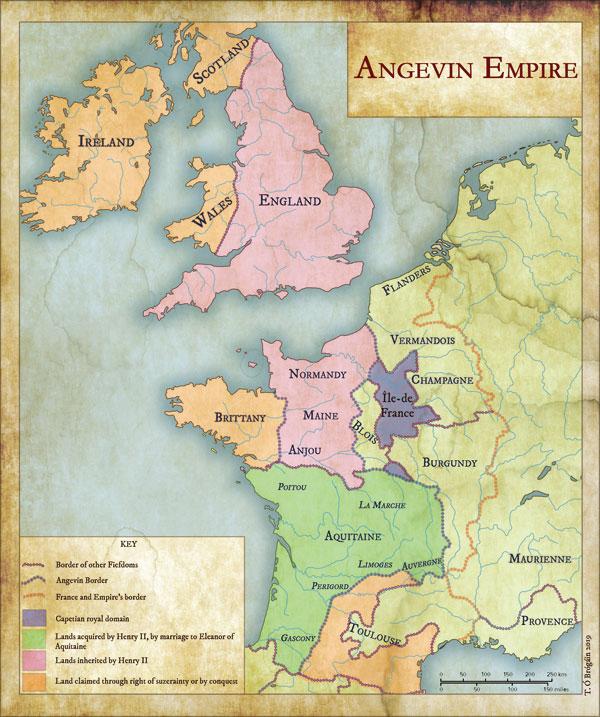
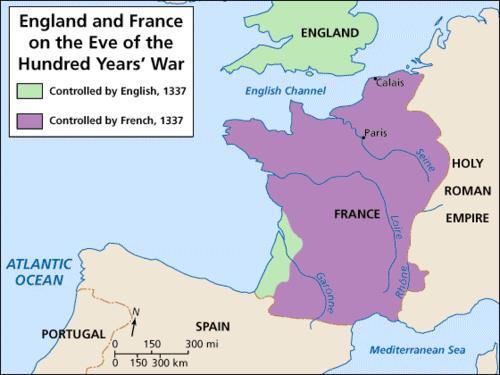
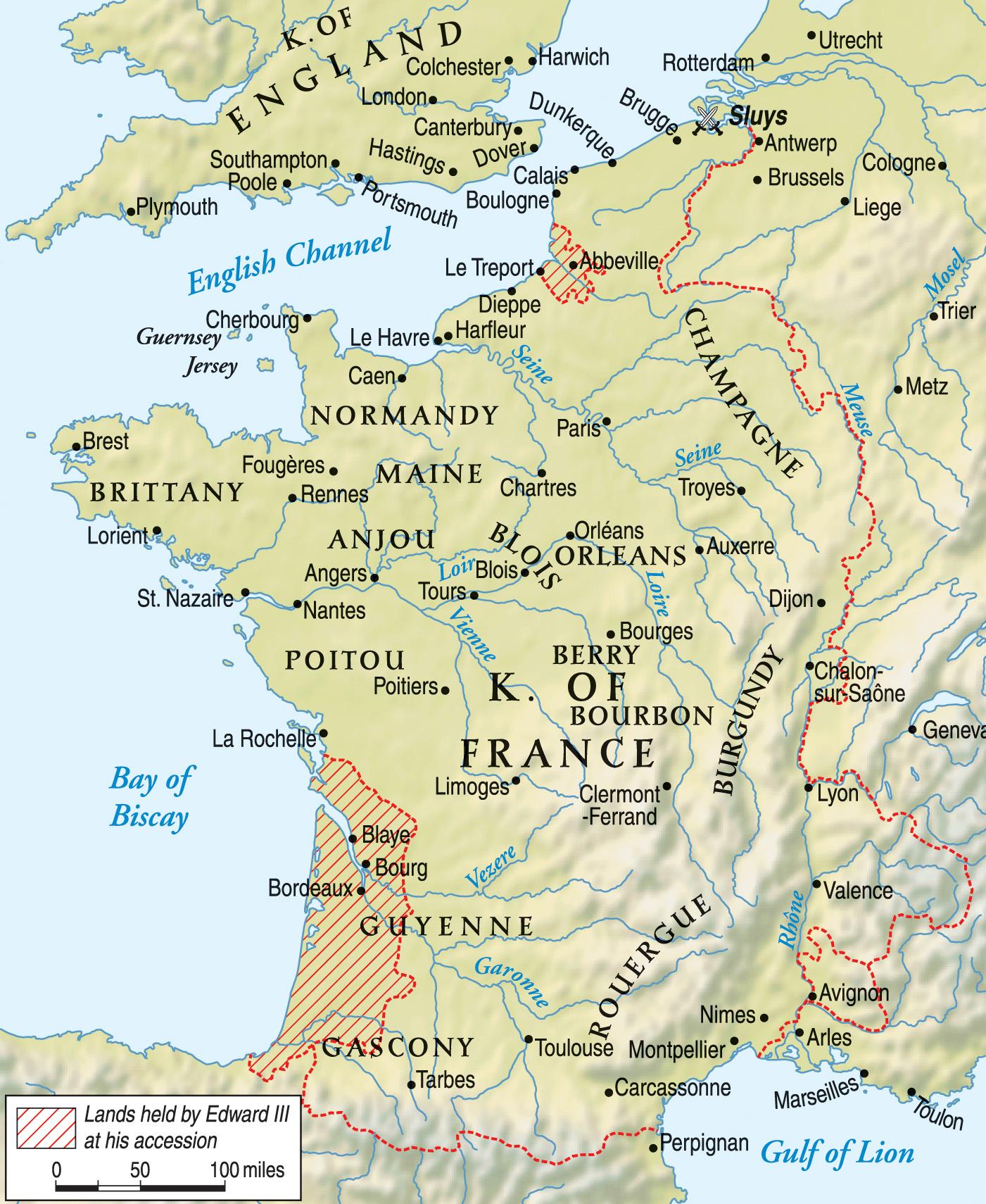
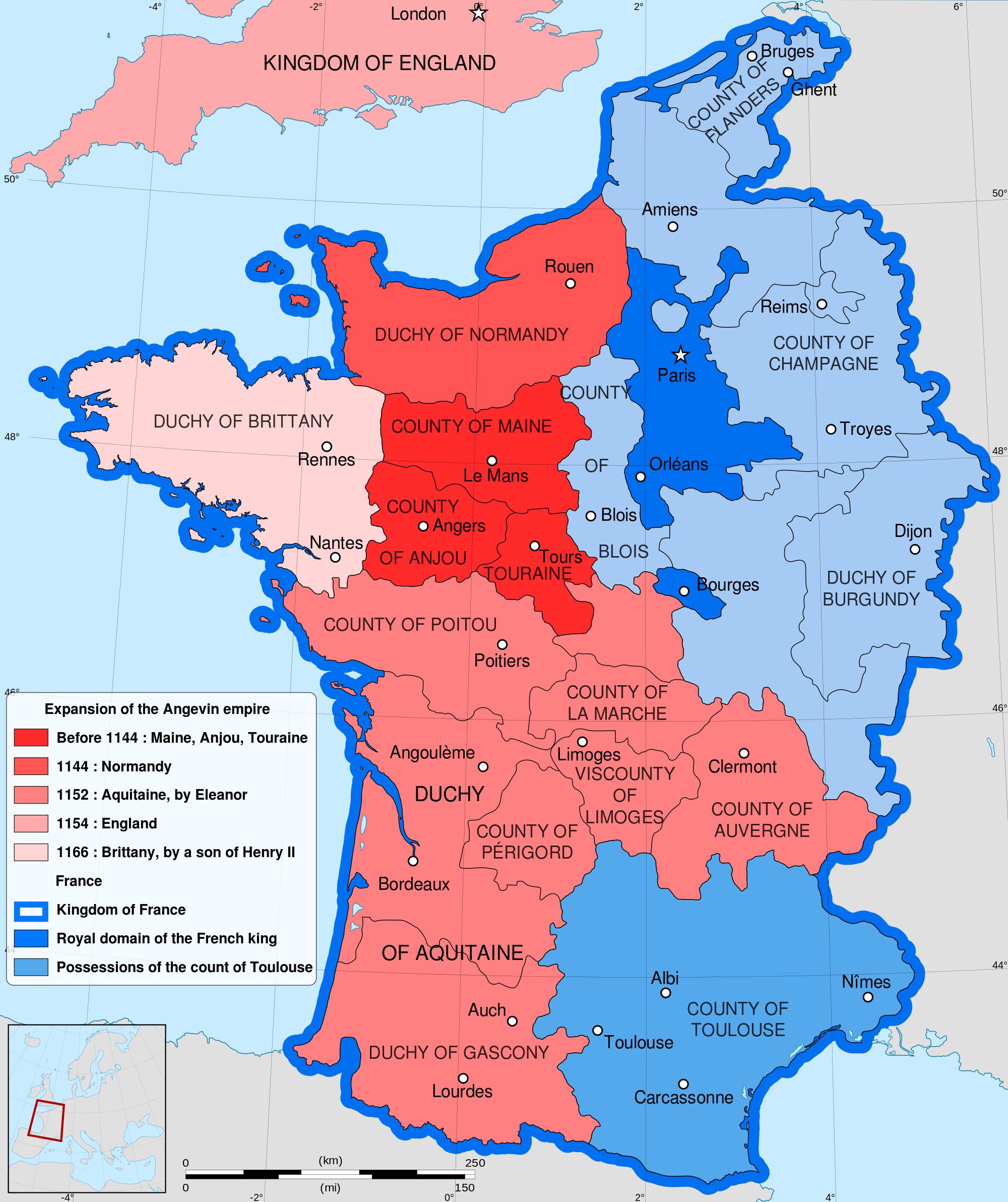
Yes — that's quite possible, and the words “Nouvelle Édition” on your title page make the question especially relevant.
Villaret was not necessarily composing every passage as an entirely new historical narrative in 1772. Eighteenth-century historical works were often assembled from earlier chronicles, memoirs, royal records and previous histories, sometimes retaining older narrative traditions while modernising spelling, grammar, or presentation. Successive editions could then make further editorial changes.
There are actually three different “ages” we should distinguish in your book:
│ The physical book: definitely printed in 1772, according to the title page. │ Villaret's composition/editing: potentially decades earlier than this particular printing. Claude Villaret died in 1766, so the text in your 1772 edition necessarily predates the physical book. │ The underlying accounts: potentially centuries older. For events around 1314–1350, Villaret could be transmitting material derived from medieval chronicles and documents, sometimes fairly closely and sometimes interpreting them through an 18th-century lens.
That third layer is the really interesting one.
For example, when your book says of Philip VI that he was courageous, magnanimous and pious, but that excessive generosity exhausted his finances and betrayal made him suspicious and inflexible, we shouldn't automatically assume Villaret invented that characterization in the 1700s. It may descend from a substantially older historical tradition.
Likewise, the Louis X passage saying he was called Hutin because he was “mutin, altier, querelleur” could be Villaret's synthesis, or it could reproduce an explanation that had already circulated for centuries.
So I'd modify something I said earlier. Calling what we're seeing simply an “18th-century perspective” is too strong without checking Villaret's sources. Some of the perspective certainly is eighteenth-century, but some may preserve much older historiographical material.
And we can actually investigate this rather than speculate. Since we now have an identifiable edition and exact passages, I can trace Villaret's sources for the Louis X and Philip VI sections, and see whether substantially the same wording/story appears in earlier French histories or medieval chronicles. That would tell us how much is Villaret and how much is inherited.
> I'm curious but not planning to spend a lot of time on it. I've never been able to read it apart from word pick. That random word pick was inadequate. You've started to completely decode it.
Yes — and this is actually a very good use for me with a book like this.
You don't need to learn 18th-century French to get something out of it. The typeface, obsolete spelling, long-s, archaic vocabulary and sentence construction make casual word-picking particularly misleading. Once I can see the whole sentence, I can usually reconstruct the grammar and translate the meaning, rather than just recognizing individual words.
And we don't need to turn it into a research project. You can simply photograph a page whenever something catches your eye and send it. I can give you:
a straightforward English translation; │ a quick explanation where an old expression means something unexpected; │ enough historical context to understand what the author is talking about; │ and flag anything that seems particularly unusual or revealing.
That effectively turns your 1772 book into something you can finally read, rather than an object where you can only occasionally recognize roi, guerre, France, Angleterre, etc.
The first and last pages already demonstrate that there's considerably more in it than those isolated words would have suggested.
> Well I picked it off the shelf because we were watching a show on Corsica, and a town 'Cour' or thereabouts was mentioned and I said "The Heart". She said no, and I said well I have the French History book.. that's how it came out
Ha! So the entire excavation of a 254-year-old French history book started because of an argument over “cour”. 😄
And your instinct wasn't unreasonable, but there are two different French words hiding there:
│ cœur = heart │ cour = court / courtyard
They sound fairly similar to an English ear, although in modern French they're distinct: cœur roughly /kœʁ/, cour roughly /kuʁ/.
If the Corsican place was actually Corte — Corte — that's probably what you heard. Corte is the historic inland town in the mountains and was effectively the capital of independent Corsica under Pasquale Paoli in the 18th century.
Yes—the two-way exchange point is important. Where I'd separate it from the Vatican/Roman-Catholic explanation is that the “single place of origin” preference isn't specifically a Catholic principle; it's largely a feature of how modern historical linguistics tries to establish descent using the simplest chain supported by dated evidence.
Your Portuguese example is a useful warning against making that principle too rigid. From the 1500s onward, Portuguese-speaking maritime networks connected Portugal, Africa, India, Malacca, China, Japan and the Philippines. Words, objects, technologies and people moved in both directions, and sometimes through several intermediary languages.
Japan provides particularly clear linguistic fossils. Japanese パン (pan, bread) derives from Portuguese pão; ボタン (botan, button) is generally associated with Portuguese botão; and other early European loanwords entered through Portuguese contact. Conversely, Europeans acquired Asian vocabulary and concepts through those same trading networks.
And something similar existed long before Portugal existed. The Mediterranean wasn't a collection of isolated linguistic boxes. Phoenicians, Greeks, Egyptians, Anatolians and others operated overlapping maritime networks. A word could potentially travel:
│ A → B → C → A
after changing pronunciation or meaning at every stage. Centuries later, the returned form might look like an unrelated word.
That's particularly relevant to your approach because cognacy and borrowing aren't the only possibilities. There can be borrowing, reborrowing, calquing, folk reinterpretation and substrate words. A geographical name is especially capable of surviving several language replacements while being repeatedly reshaped to sound meaningful to the current population.
Where conventional linguistics has a very useful safeguard, though, is chronology. Similarity alone produces enormous numbers of accidental matches. If we're investigating your Corsica / K-R-S-K idea, the strongest method would actually exploit your two-way-network argument: find the earliest dated forms at different points around the Mediterranean, rather than deciding beforehand which culture must have originated the word.
Then the evidence might reveal something much more complicated than a straight arrow.
That's also why the 1772 French book you've just pulled down is interesting in an unexpected way: old texts preserve spellings, names and explanations before some later standardisations occurred. They aren't automatically more historically accurate, but sometimes the variant itself is valuable evidence.
> Well I've been in the real world and seen the obvious with my own eyes. Jewish Communities have sought to hide far away from dangerous enemies. Often trying to remain invisible. Like Zermatt in Switzerland. When you see a Jewish kippar in a museum found at the town's dig foundations and a semi-readable 'The Mount' it's obvious that general civilisation moved in on their once remote settlement (Stetl'Mont=town on a hill)
I think there are two separate propositions there, and one is much easier to establish than the other.
The first — Jewish communities sometimes deliberately settled where they could survive with a degree of isolation, and sometimes minimized their visibility under hostile conditions — certainly has historical examples. So archaeological evidence of a Jewish presence somewhere that later became culturally quite different shouldn't automatically be surprising.
The second proposition — that particular evidence at Zermatt demonstrates an early Jewish settlement and that Zermatt derives from something like “Stetl'Mont” / town on a hill — is a specific archaeological and linguistic claim. That's where I'd want to see exactly what you saw before either accepting or dismissing it.
And eyewitness context matters here. If you stood in the museum and saw an excavated object that the museum itself identified as a kippah or Jewish head covering, alongside an inscription that appeared to say something corresponding to “the Mount,” that's substantially more interesting than somebody noticing that Zermatt resembles a reconstructed phrase on the internet.
But I'd still keep three questions separate:
│ What is the artefact? │ What date did the excavation assign it, what material is it, and why was it identified as Jewish? │ │ What does the inscription actually say? │ If it's Semitic, the individual letters matter enormously. A photograph could potentially let us read or reconstruct it. │ │ What is the history of the name Zermatt? │ That can be investigated independently through the earliest recorded forms. If the name changes through documented forms over centuries, those forms give us something much stronger to test Stetl'Mont against.
That's actually the sort of investigation I'd enjoy doing with you because we don't have to choose beforehand between “the standard etymology must be correct” and “the alternative must be correct.” We can put the museum evidence, archaeological dating, earliest written place-name forms, and proposed Semitic reading next to each other.
If you happen to have a photograph of that Zermatt museum display, that would be the thing I'd most like to see. The inscription in particular could give us something concrete to work from.
> This is the challenge of Heichalot-CMS. To expose a layer of deliberately hidden and obscured Human civilization.
Yes — and I think the important distinction for Heichalot-CMS is between exposing evidence that has been overlooked or obscured and deciding in advance that every gap was deliberately concealed.
The CMS can be particularly useful because it lets you preserve the chain of evidence. Instead of reducing something like Zermatt to “Jewish settlement” versus “not Jewish settlement,” an entry can retain the photograph, museum description, excavation context, inscription, proposed reading, historical spellings, conventional interpretation, and your alternative interpretation side by side.
That makes the unconventional material much harder to dismiss casually, because the reader doesn't have to trust the conclusion. They can inspect the underlying evidence.
It also gives you a useful classification that I think fits what you've been building:
│ Observed → independently documented → interpretation → hypothesis.
For example, “I photographed this object in the Zermatt museum” is an observation. “The museum dates it to X excavation layer” is independently checkable documentation. “These marks appear to read ___” is an interpretation. “This indicates an early hidden Jewish settlement” is the larger hypothesis.
And sometimes deliberate concealment itself can become an evidence-backed conclusion—but then you'd want evidence of the concealment too: changed catalogue descriptions, destroyed records, explicit prohibitions, contradictory inventories, correspondence, etc.
That approach doesn't weaken the purpose of Heichalot-CMS. It makes it considerably stronger. Someone can disagree with your interpretation and still discover that the underlying object, text or historical anomaly is real and worth investigating.
Your French book is almost a miniature example of the same problem. For years it was physically sitting there, but the information inside was effectively inaccessible to you. Nothing had to destroy it; language, typography and time were sufficient to hide the information in plain sight.