The Ancient Symbol of the Ancient Sardinians of the Shardana
The Egyptians therefore said that the people of the sea, the Shardana, were identified as belonging to Sardinia, in the centre of the Mediterranean.
The Ancient Symbol of the Ancient Sardinians of the Shardana
But I don't want to dwell too much on the historical aspect of the Shardana. There are very interesting and in-depth publications on the subject by many established scholars.
What I would like to underline and explore in more detail is the symbolism of this symbol, witness and bearer of what was the true nature of the Ancient Sardinians.
A symbol that reveals much more than it seems, which fit together perfectly, and with the other pieces, which contribute to reconstructing the true history of our civilization.
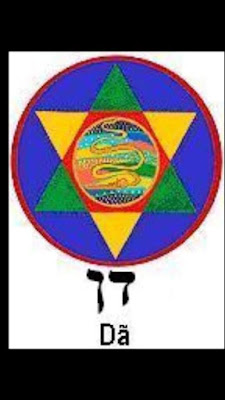
It is presented as a symbol of the tribe of Dan and is introduced by this explanation:
"Blessing of Father Jacob (Dan was one of the twelve sons of Jacob, had by the servant of his wife Rachel, sterile, the great patriarch of the Hebrews, eponymous hero of the people of Israel, called by God himself, by JHWH, with the name of Israel, as he wrestled with the Lord and won)
"Dan will protect his people like all the other tribes of Israel. Let Dan be like a snake by the wayside, a horned snake (editor's note: a snake common in North Africa) by the road, that bites the horse in the heel, so that its rider falls backward. ([The rider (puts) the horse bitten in the heel backward]) I hope, O Lord, for your salvation." (Genesis 49:16-18)
Let's look at the symbol
A round circumference like the Nuraghi, a matrix figure of containment
A primordial uterus, like the nuraghi, which even in their internal arrangement, often seem in the plan, to be wombs with Fallopian tubes, a uterine duct in honor of the Creator Mother Goddess.
A red circle.
A circle enclosing a Star of David, two intersecting triangles
The triangle, as we have already seen in my previous posts, represents the trilobate, the nucleus of creation, the Flower of Life, of the trilobate Nuraghi
I have already said many times that the Star of David is as if it were a representative Sardinian symbol, since it represents that synergistic balance between masculine and feminine polarity, which the ancient Sardinian alchemists always took into account, to the point of representing it as the flower of life and a six-pointed star, carved into the Maschera dei Boes, the Sardinian carnival mask and in the six-pointed star of the Sartiglia, a horse race that takes place every year in Oristano, aimed at the conquest of this star by a deified human figure, "Su Componidori", that is, he who composes, who creates, who creates abundance through the synergy of opposites, represented by the six-pointed star.
The colors of these two intersecting triangles, present a green triangle and a yellow one
Yellow like the deity of the god Taurus / sun, the deity of all the spirituality of the Ancient Sardinians
Green because Sardinia was once called the island of great green
Here's what Professor Dedola says about Sardinia's definition of a green island:
Sardinia was known as such. Isola del Grande Verde was an antonomastic crown name, since the island was nestled in the center of the Mediterranean (called the Grande Verde), far from any coast, distant but attractive for all its riches.
The Great Green: that's what the Egyptians also called it. And when they described the Sea Peoples, they always claimed they came from the Great Green, which they called Uatch-ur, 'the Great Green water,' or the Mediterranean Sea. If you know how to interpret it phonetically, the Egyptian Uatch-ur is the etymological basis from which the German Wasser and the Anglo-Saxon water also derive. This is a Mediterranean and pan-European word, but it did not replicate, except in semantics, the way the Akkadians, Assyrians, and Babylonians called the Mediterranean for themselves: Iqnû-sû 'that (the sea) of Lapis Lazuli.'"
As for blue, we know that it is a primary color, Cyan Blue, like the one in the image.
Primary like the color yellow
Green is a secondary color, obtained from yellow with the addition of blue.
But blue is also important for another reason. The ancient Sardinians are said to have been called "blue men."
The apocryphal gospels speak of these earthly angels who presumably came from Sirius and who mated with earthly women, and who apparently were blue, like the inhabitants of Atlantis, like all the main deities Osiris, Vishnu, Thoth...
Even the Berbers of North Africa, the Tuareg, whose symbol is an Amazigh identical to the Sardinian symbol of the upside-down, are called blue men, perhaps because of the dyes on their clothes, or indeed because of their stellar origin.
Of course it is strange that the same symbol is also present in our Domus de Janas
Ancient Sardinians and Tuareg, both, called Blue Men
But let us return to the symbol of the Dan, the seal of the Dan tribe.
On the 6-pointed Star, before introducing the discussion on the letter Nun, and on the letter Dalet, I wanted to underline that the history of Jewish biblical humanity is divided into three parts, that of Adam, of Noah and of Abraham, grandfather of Jacob, whose father was Isaac.
The history of humanity has always been cyclical, and all three names Adam / Noah / Abraham, the father of Jacob, have a gematric value equal to six, like the 6-pointed star and the flower of life.
Gematria is a theological science of Judaism, which studies the words written in the Hebrew language and attributes numerical values to each letter.
It seems that words with identical numerical values are related, and this is one of the methods used by the Kabbalah.
But let's talk about the Holy Letters Nun and Dalet
The letter Nun is geometrically represented by a rhombus
The ancient Egyptians represented it as a small rapid in motion and extension, with small triangles close to each other.
It has a numerical value of 50 and symbolically represents the fish
For the ancient Egyptians it was water, that double zigzag, energy, the water from which everything originated, the primordial sea.
Nun Indeed was together, the cosmogonic divinity who represented the element of water primordial waters, the primordial sea
Nun is in fact the original father, the androgynous, the cosmogonic couple of the universal creative waters, Nun and Nunet, of which I already spoke in a previous post of mine.
Considering that the word Nuraghe has as its root, "NU-", which is the same root as both "nun", which represents water, and Nur, which represents fire, we already understand the importance of this Hebrew letter, the fourteenth Sacred Archetype.
It is clear that the nuraghe itself represents that original and androgynous divinity which contains within itself both the fire element and the water element.
But the extraordinary thing is that "Nun" represented the primordial greeting, called "NYNY", whose sign was a man transmitting energy, like a zigzag lightning, like the greeting of our Sardinian Bronzetti, who have almost the entire palm of the hand facing forward.
The power to transmit energy, which is transmitted like a zigzag lightning bolt
And this being a "man of power who transmits energy" can only mean one thing: that they were ancient thaumaturgical shamans, healers, with the gift of healing through the palm of their hand.
Pranic shamans, who knew the energies of the universe very well, and who radiated them through their hands, for therapeutic purposes.
Even today, in Sardinia, it is customary to greet others in Sardinian by saying "saludi", "salute"
Tiziana Fenu
©®All rights reserved
Maldalchimia.blogspot.com