Giant Sword at Oyamazumi Shrine
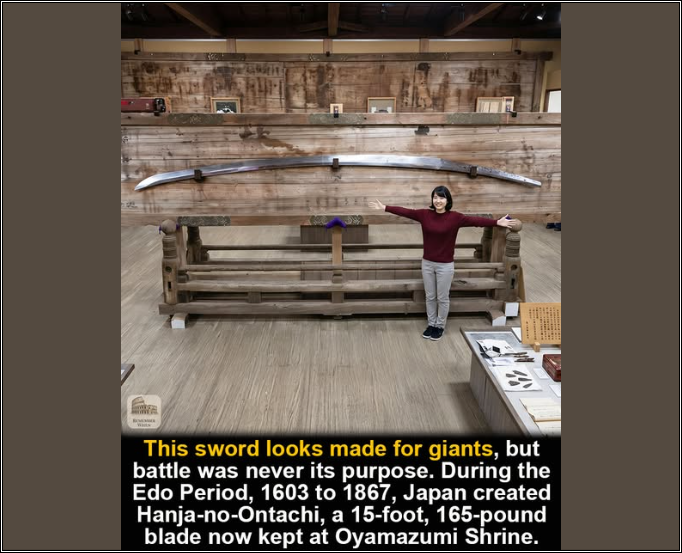
It looks like proof that giants once walked Japan. But Hanja-no-Ontachi is more complicated than legend. Preserved at Oyamazumi Shrine, this enormous Japanese sword dates to the Edo Period, 1603 to 1867, and measures roughly 15 feet (4.65 m) long while weighing about 165 pounds (75 kg). Few artifacts command a room the way it does. At first glance, many assume it was built for war. In reality, a blade of this size would have been extremely difficult to draw, maneuver, or use in ordinary combat. Its dimensions point instead toward symbolism rather than practical battlefield design.
Across Japan, shrines received swords as sacred offerings. Weapons could represent divine favor, protection, gratitude after victory, or a wish for peace in dangerous times. Hanja-no-Ontachi is often described as being made to repel evil and promote harmony.
That creates an intriguing contradiction. Something shaped as a weapon may have served mainly as a prayer. Steel, weight, and intimidation were transformed into ritual meaning. The object threatened enemies in form, while seeking peace in purpose.
Folklore later added another layer, stories that such a blade belonged to giant people or superhuman warriors. No solid historical evidence supports those claims, but legends often gather around objects too unusual to ignore.
Today, visitors still stand beneath its curve and wonder what matters more, the history we can document or the myths extraordinary objects continue to create.